Folding-Driven Auxetic Weft Knit Textiles with Integrated Capacitive Sensing
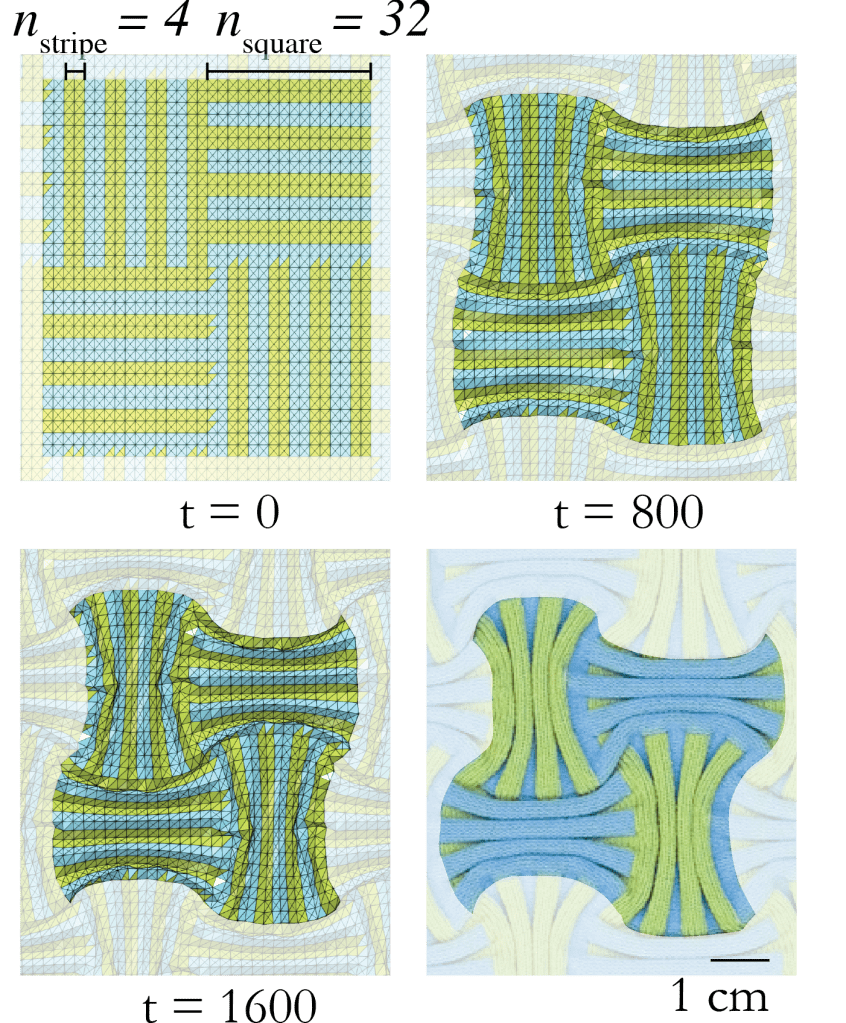
Combining simulations with experiments, we show that the programmed unfolding of corrugations in knit textiles generates tunable auxetic behavior. We integrate capacitive strain sensing directly during fabrication through partial plating of conductive yarns, eliminating post-processing. The resulting knitted capacitors exhibit programmable tradeoffs between strain sensitivity and sensing range, enabling either highly sensitive sensors over narrow deformation windows or lower-sensitivity sensors capable of measuring larger strains. Available on the Arxiv
Knitting Multistability
We present a unique way of knitting curved elastic shells that exhibit multistability and snap-through behavior, weft-knitting. The knitting process introduces internal stresses into the textile sheet, which leads to complex 3D curvatures. We harness the snapping behavior and shape change through multistability to design soft conductive switches with built-in haptic feedback, and incorporate these textile switches into two wearable devices and one reconfigurable lamp. This work will allow us to harness the nonlinear mechanical behavior of textiles to create functional, soft, and seamless devices. Published in Advanced Functional Materials.

3D knit pneumatic actuators for wearable haptic displays
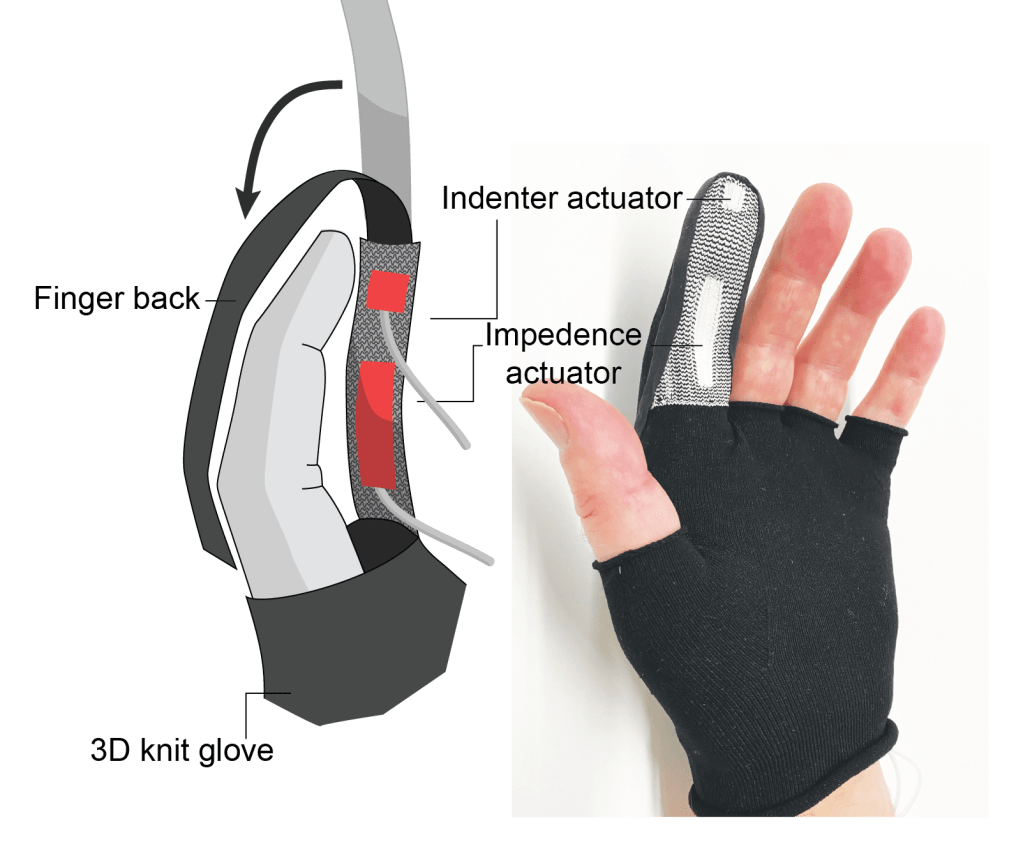
We leverage the benefits of 3D weft knitting to develop a novel method of manufacturing small scale (5-8 mm) pneumatic actuators that can be embedded across a distributed textile surface. Weft knitting enables seamless transitions between contrasting yarns and textile structures, which increases manufacturing resolution for small-scale actuators. We demonstrate that 3D knit textile actuation properties, such as blocking force, free displacement, and bending stiffness, can be tuned by manipulating actuator design parameters. Published in Extreme Mechanics Letters.
3D knitting for pneumatic soft robots
In this work, the roles of knit structure and yarn material properties on textile mechanics spanning three regimes–unfolding, geometric rearrangement, and yarn stretching–are elucidated and shown to be tailorable across unique knit architectures and yarn materials. Based on this understanding, 3D knit soft actuators for extension, contraction, and bending are constructed. Combining these actuation primitives enables the monolithic fabrication of entire soft grippers and robots in a single-step additive manufacturing procedure suitable for a variety of applications. Published in Advanced Functional Materials.

Bachelor’s thesis: Growth and dynamics of brinicles
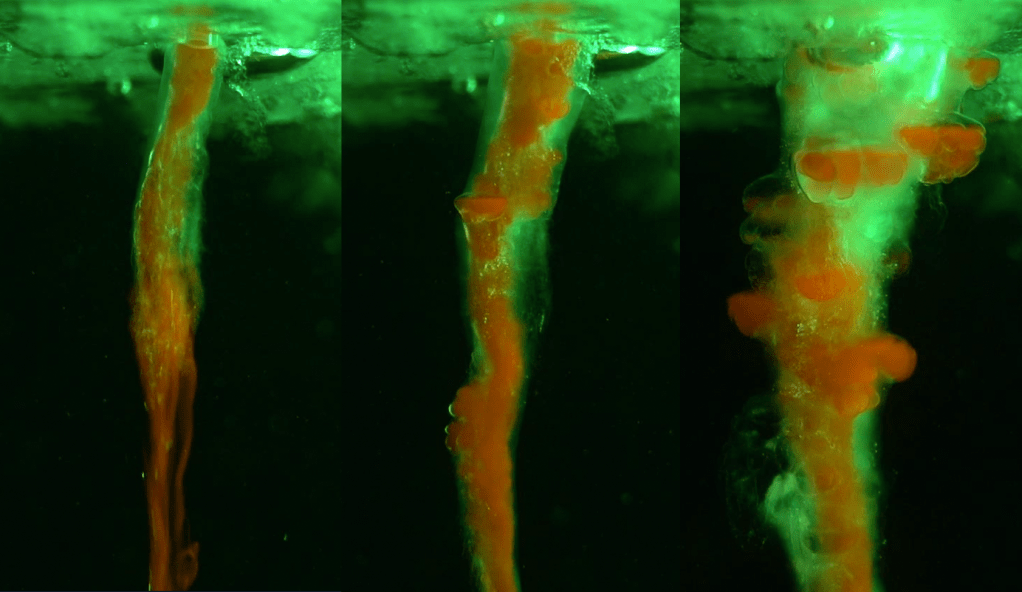
A brinicle is an underwater stalactite that forms when brine at a temperature lower than the freezing temperature of water is ejected from sea ice and into the ocean below. The ocean water freezes around this stream, and as the brine is ejected the brinicle grows in both length and width.

 Kausalya Mahadevan